A Plea for the Human Head :
Petrides and the Sculptural Canon
From ancient Egypt to the contemporary era, the human head has established itself as the privileged locus of sculptural expression, capturing the entire spectrum of the human condition: domination, piety, memory, and vulnerability. George Petrides’s Hellenic Heads do not fit into this lineage as simple portraits, but as a deliberate confrontation. By appropriating the monumental format—once reserved for pharaohs, divinities, and statesmen—Petrides invests it with the inherited anxieties and resilience of a Greek family marked by the tumults of the twentieth century. The series thus engages in a rigorous dialogue with the canon, aligning with and diverging from, in turn, the pharaonic tradition, Phidias, Michelangelo, Rodin, Brancusi, Giacometti, Bourgeois, and Schütte.
Phenomenologically, the heads assert their presence even before delivering their narrative. Standing on pedestals to reach a total height of over two meters, these six busts command space like historical monuments. Yet, they do not demand allegiance, but recognition. From afar, they read as imposing silhouettes; from close up, the topography of their surface—scarified, textured, and tactile—renders their story tangible. They convey not only a psychological depth, but a physical mass: the ridges of the clay and the sharp incisions witness the pleasure of modeling. Whether subjected to the changing light of the outdoors or the raking light of a gallery, these surfaces transform the static head into a landscape of accumulated experience.
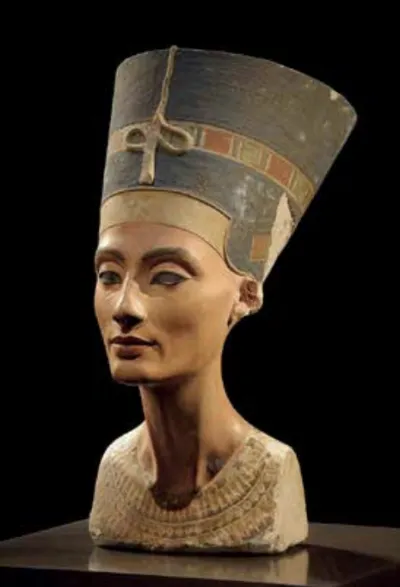
Bust of Nefertiti, New Kingdom, 18th Dynasty, c. 1351–1334 B.C., Egypt, Tell el-Amarna. Neues Museum, Berlin. Photograph: Philip Pikart.
Pharaonic Precedents: Dialectic of Authority and Rupture
Ancient Egyptian statuary constitutes the primordial ancestor of the Hellenic Heads. The bust of Nefertiti (c. 1345 B.C.), a canonical icon of the Amarna period, projects a "contained authority." Although it was probably a workshop model intended to standardize the royal image, its slight asymmetries suggest a reality observed beneath the icon.¹
Petrides borrows from these works the raw factuality of command: his heads, too, possess an undeniable physical gravity. However, the resemblance is invoked only to be subverted. Where pharaonic statuary irons out imperfection to assert the stability of absolute monarchy, Petrides’s surfaces admit rupture. Tool marks and abrasions remain visible, evidence of a struggle with material and history. If the Egyptian head idealizes an eternal sovereign, Petrides’s heads expose the vulnerable humanity of those who endured the fractures of modernity. They present identity not as a fixity, but as an entity destabilized by migration, yet capable of a reconstructed dignity.
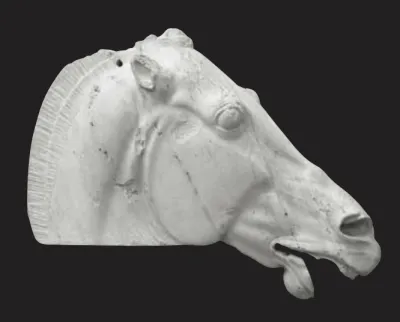
Head of a horse of Selene, 5th century B.C. (438–432 B.C.), marble sculpture from the east pediment of the Parthenon, attributed to a project by Phidias. The British Museum. Photographic archives of Melissa Publishing House.
Phidias: The Individual within the Myth
With the Parthenon sculptures of Phidias (5th century B.C.), the head becomes an instrument of the polis. The Head of a horse of Selene serves here as a proxy for lost human figures: its dilated nostrils and gaping jaw translate a pure and exhausted realism, anchoring the myth of Athena’s birth in a physical truth.³
Hellenic Heads shares this use of the head as a vector of collective narrative, but reverses its temporal logic. Phidias captures a single mythic instant; Petrides captures the accumulated weight of decades. The series spans a generational procession—from the trauma of the Smyrna Catastrophe of 1922 to the complexities of contemporary diasporic identity. In Phidias, the head confirms a public myth; in Petrides, it records the private cost of national history—manifested in silence, caution, or resilience. Both bind the individual to the historical arc, but Hellenic Heads reveals the weight of what is carried within.
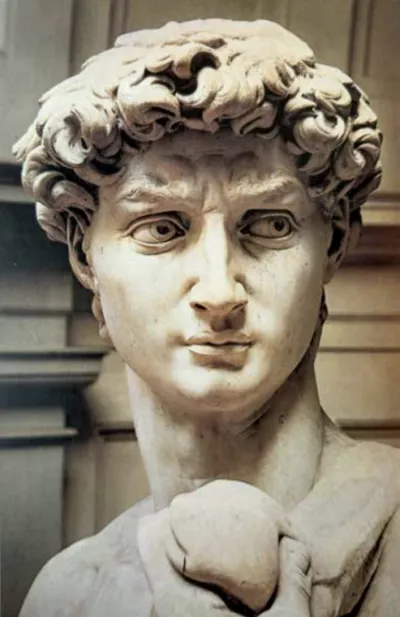
Detail of the head of David. White marble sculpture by Michelangelo Buonarroti, 1501–1504. Galleria dell’Accademia di Firenze.
Michelangelo: The Engine of Will
Michelangelo’s David (1501–1504) posits the head as the seat of intellect and will. The furrowed brow and focused gaze capture the "engine of decision"—that moment of tension preceding action—privileging the mind over brute force.⁴
Petrides prioritizes the inner life but rejects Renaissance idealism. His surfaces are not polished to perfection, but inscribed by the passage of time. Where David stands at the precipice of his story, filled with potential, Petrides’s figures stand in the aftermath. Their scale suggests endurance: lives rebuilt and continuity assured despite the ravages of war and scarcity. In David, the narrative is linear and triumphant; in Hellenic Heads, it is recursive—an inherited memory that echoes through generations until it is recognized and transmuted.
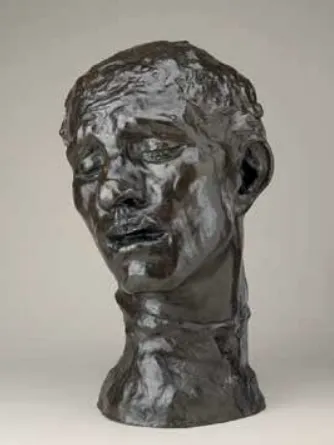
Monumental Head of Pierre de Wissant, bronze, by Auguste Rodin, c. 1884–1885. North Carolina Museum of Art.
Rodin: The Anti-Monumental Turn
Auguste Rodin’s studies for The Burghers of Calais (1884–1889) function as "anti-monuments," rejecting heroic convention to depict isolation and anguish. The Monumental Head of Pierre de Wissant makes inner suffering visible, stripping away the facade of nobility to reveal the trembling individual.⁶
This connection is foundational for Petrides, who cites the Burghers as a conceptual precedent. His figures are also "burghers" of a new kind, carrying the weight of geopolitical decisions made elsewhere. However, while Rodin’s figures are caught in a moment of sacrificial crisis, Petrides’s heads contain time itself. The "crisis" here is not an event, but a condition: the sustained anxiety of post-war survival and the quiet courage of daily continuity. Rodin's drama is historical and public; Petrides's is familial and psychological, though projected on a civic scale.
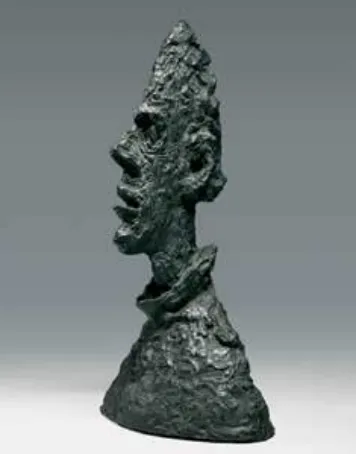
Large Thin Head (Grande tête mince), 1954. Bronze by Alberto Giacometti.
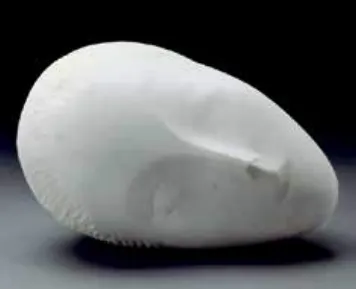
Marble version of Sleeping Muse (1909) by Constantin Brancusi. Hirshhorn Museum, Washington (D.C.). Brancusi made several bronze casts of this work, now held in museums worldwide, notably the Metropolitan Museum of Art (New York), the Musée National d'Art Moderne (Paris), and the Art Institute of Chicago.
Brancusi and Giacometti: Essence and Existentialism
Within the Parisian avant-garde, Constantin Brancusi and Alberto Giacometti dismantled the head to reach its essence. Brancusi’s Sleeping Muse (1910) reduces the face to a polished, archetypal ovoid.⁷ Conversely, Giacometti’s Large Thin Head (1954) thins the face to a "knife edge" of existential fragility, embodying the alienation of the post-war era.⁸
Petrides operates a synthesis between these extremes. Like Brancusi, he simplifies form for clarity; like Giacometti, he embraces elongation to suggest temporal stress. Yet Petrides insists on specificity. He connects monumental form to a genealogy and a geography. While Brancusi and Giacometti distilled the head into an absolute, Petrides reclaims it as a vessel of lived memory, positioning his work at the intersection of universal archetype and specific personal history.
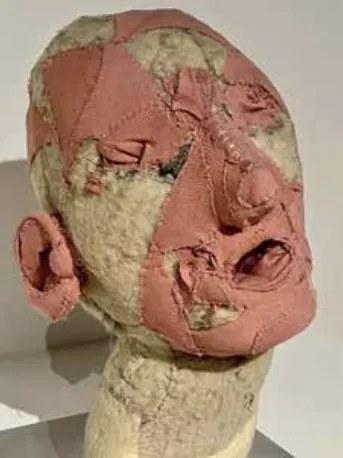
Untitled, Louise Bourgeois.
Bourgeois: The Psyche as Public Architecture
Louise Bourgeois’s fabric heads (e.g., Untitled, 2001) relocate the monument within an interior psychological space. Enclosed in vitrines—which she termed "cells"—these works map the architecture of fear and memory.⁹
Both artists draw from autobiographical material and maternal lineage. However, where Bourgeois emphasizes confinement and private vulnerability, Petrides carries interiority into the agora. He casts these intimate psychological states in bronze and stone, exposing them to the elements. He argues that the private consequences of history deserve a place in public space. The "cell" is opened, and the intimacy of family memory is amplified to a civic scale, demanding that society recognize the private burdens of its history.
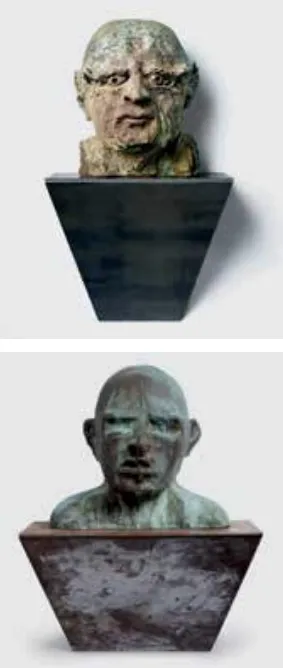
Wichte (Imps), Thomas Schütte.
Schütte: Monumentality and Sincerity
Thomas Schütte’s Wichte (Imps) resurrect the bust only to mock it, presenting "brutalized and grotesque faces" that undermine the authority they seem to project.¹⁰
Petrides shares Schütte’s interest in the unsettling power of the enlarged figure, but diverges on ethics. Where Schütte employs irony to expose the vacuity of state power, Petrides employs sincerity to honor the labor of survival. His monumentality is not a critique of the format, but a reclamation. Hellenic Heads transforms the language of power into a commemoration of resilience.
Coda: A New Voice in the Debate
Through these comparisons, Hellenic Heads emerges as both a student of the canon and a distinct voice within it. Where the ancients projected ideals and the moderns exposed fragmentation, Petrides offers a synthesis: a monument to the "postmemory" of trauma.¹¹
He accepts the risk of monumentality, but fundamentally alters its subject. Instead of honoring conquerors, he honors those who endured the consequences—refugees, survivors, silent builders. He uses the ancient language of stone and scale to make visible the quiet work of survival and the transmission of trauma across generations. At a time when the function of the monument is being radically reconsidered, Petrides offers a compelling answer: a monument to vulnerability, to endurance, and to the human head that bears the weight of history.
¹ On the Bust of Nefertiti (c. 1345 B.C.) as an icon of authority and a workshop model, see Neues Museum, Berlin, “Bust of Nefertiti,” Collections Online. On Nefertiti's status as co-regent, see Google Arts & Culture, “An Audience with Nefertiti,” Neues Museum.
² On the sculptural program of the Parthenon, see Joan Breton Connelly, The Parthenon Enigma (New York: Alfred A. Knopf, 2014).
³ British Museum, “Head of a horse of Selene from the east pediment of the Parthenon,” Collections Online. On the interpretation of the horse's "exhaustion," see Getty Museum, “Studies of Horses,” Collection Online.
⁴ The interpretation of David (1501–1504) depicting the moment before the encounter is the dominant academic position. See Accademia.org, "Facts About David". Michael Hirst, Michelangelo and His Drawings (New Haven: Yale University Press, 1988).
⁵ On the analysis of the "furrowed brow" as the "seat of thought," see Galleria dell’Accademia, “David,” collection entry, Florence.
⁶ On Rodin's head studies, such as the Monumental Head of Pierre de Wissant (c. 1884–85), see the collections of the North Carolina Museum of Art and the Brooklyn Museum. On the concept of "anti-monument," see The Guardian and The New York Public Library.
⁷ On Brancusi’s Sleeping Muse (1910), see The Metropolitan Museum of Art, “Sleeping Muse,” Collections Online. On the ovoid shape as "archetype," see Centre Pompidou, "The Endless Life of Constantin Brancusi".
⁸ On Giacometti’s Large Thin Head (1954) and existentialism, see Fondation Giacometti, Paris, and Christian Klemm et al., Alberto Giacometti (New York: MoMA, 2001).
⁹ On Bourgeois’s fabric heads, see Irish Museum of Modern Art, “Untitled” (2001), and The Easton Foundation.
¹⁰ On Schütte's Wichte series (c. 2006) as a "mockery of power," see Pinault Collection, “Wichte”, and Museo Reina Sofía.
¹¹ Marianne Hirsch, The Generation of Postmemory: Writing and Visual Culture After the Holocaust (New York: Columbia University Press, 2012). On the application of postmemory to Greek diaspora trauma, see PMC and Peri-technes.