Sculptural Precedent
The influence of classical forms in the artist's work.
I have long been seized by Michelangelo’s protean genius, tirelessly seeking to understand how a single mind could achieve excellence in so many disciplines—from drawing to sculpture, painting to architecture, even poetry and the wise management of his affairs. Beyond academic study of William Wallace’s lectures, Carmen Bambach’s exhibitions, or Irving Stone’s biographical accounts, I had the privilege of physically confronting my gaze with his entire body of work.
In my search for a sculptural precedent for The Refugee—and guided by the name of my maternal grandmother, Maria, herself a refugee from Smyrna—I naturally turned to the three Pietàs sculpted by Il Divino over six decades: the St. Peter’s Pietà (1498–1499) in Rome; the Bandini Pietà (1547–1555) in Florence; and the Rondanini Pietà (1552–1564) in Milan. While each nourished the conception of my work, I will distinguish the Rondanini here as a major influence.
The Rondanini Pietà, begun even before the completion of the Florentine Deposition, witnesses the artist’s ultimate struggle with the material. In his final days, Michelangelo carved the marble block with such fervor that only the Christ’s right arm remains from the original design. The elongated figures of the Virgin and Christ mark a radical departure from the idealism of his youth.
This unfinished state—the non finito—aligns with the master’s late evolution, moving away from humanist naturalism to embrace a mystical neoplatonism. In this vision, the sculpture is conceived as latent within the marble, requiring only the removal of the superfluous. In doing so, Michelangelo seems to have stripped his human symbols of their corporality in an attempt to convey, without mediation, a purely spiritual idea.
Beyond the expression of the Virgin Mary, I was fascinated by the rough texture Michelangelo left on the entire surface. Did he leave the work as it was due to lack of time, or was it a deliberate aesthetic decision? It has been suggested that the sculpture should not be considered unfinished, but as a work in a continuous process of "revelation," made visible by the viewer as they move around it.10
10 Wikipedia contributors. Rondanini Pietà. In Wikipedia, The Free Encyclopedia. Retrieved October 17, 2024.
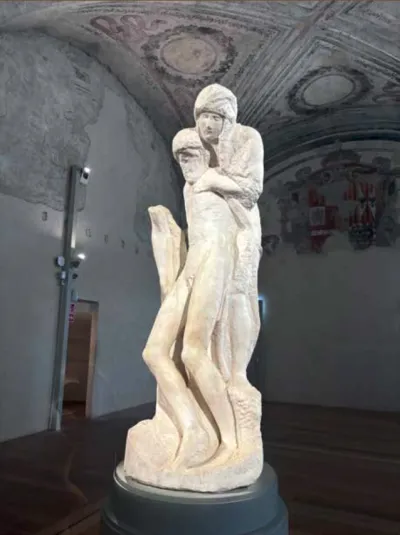
Rondanini Pietà (1564), by Michelangelo
Castello Sforzesco, Milan. Photograph: Julius Barclay — personal work.