Sculptural Precedent
The influence of classical forms in the artist's work.
This sculpture, Thalia, Muse of Comedy, was unearthed during excavations at a Roman villa near Tivoli and is believed to date back to the second century. It is based on Greek models from the late fourth to early third centuries B.C., illustrating Roman art's reliance on Greek originals. Many of these original Greek sculptures have been lost and are known to us only through Roman-era copies like this one.
The sculpture depicts Thalia, the eighth born of the nine Muses. The villa where she was discovered in 1775 was initially attributed to Cassius, known as one of the primary instigators of the assassination of Julius Caesar, though more recent research has questioned this. In traditional iconography, Thalia is described as "a young woman with a joyous air, crowned with ivy, wearing boots and holding a comic mask in her hand. Many of her statues also carry a bugle or a trumpet—instruments designed to support the actors' voices in ancient comedy—or, occasionally, a shepherd's staff or a crown of ivy."8
I was inspired by the beauty and mood of this work, and by the details of the crown and hair, which contrast with the more simply defined treatment of the face. When I began to make a version of it in my studio, without prior intention or awareness, my sculpture slowly acquired the features of my mother—specifically as a woman in her twenties—based on a black-and-white photograph taken in a garden in Athens where she is sitting and talking with a cousin. As the work progressed, the only remaining elements of the Vatican's Thalia were the crown and the hairstyle; the features transformed to suggest my mother at that specific time in her life and in that place.
8 Wikipedia contributors. (June 7, 2022). Thalia (Muse). In Wikipedia, The Free Encyclopedia. Retrieved July 24, 2022, from https://en.wikipedia.org/w/index.php?title=Thalia_(Muse)&oldid=1092041177
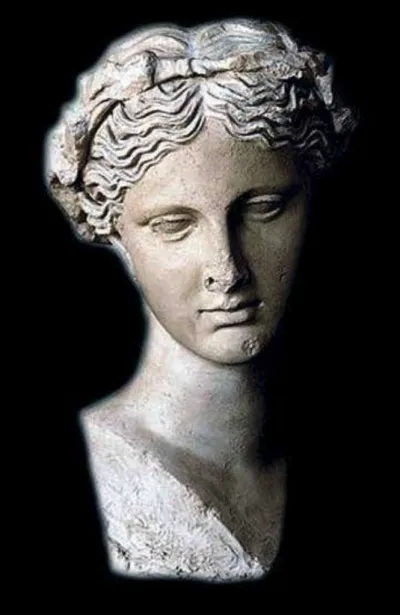
Thalia, Muse of Comedy and Pastoral Poetry
Roman copy of a classical Greek original. Vatican Museums, Rome.