Sculptural Precedent
The influence of classical forms in the artist's work.
Rodin being one of my favorite sculptors, I was very familiar with the work The Burghers of Calais, and for this project, I focused on the Head of Pierre de Wiessant.
According to Wikipedia, "In 1346, Edward III of England, after his victory at the Battle of Crécy, laid siege to Calais, while Philip VI of France ordered the city to resist at all costs. Philip failed to lift the siege, and starvation eventually forced the city to begin negotiations for surrender."16
"The contemporary chronicler Jean Froissart (c. 1337 – c. 1405) records what followed: Edward offered to spare the population if six of its leaders surrendered themselves, presumably to be executed. He demanded they walk out wearing nooses around their necks and holding the keys to the city and castle. One of the wealthiest notables of the city, Eustache de Saint Pierre, volunteered first, soon joined by five other burghers. Saint Pierre led this group of volunteers to the city gates. It is this moment—and this poignant mixture of defeat, heroic sacrifice, and willingness to face imminent death—that Rodin captured in his sculpture, executed on a scale slightly larger than life."16
Rodin produced "two models and a study of Pierre de Wiessant before the final sculpture. The first model shows the young man pointing to himself with his right hand, as if questioning his final destination. In the nude study, he no longer points to himself, but uses his arm in a defensive gesture."17
16 Wikipedia contributors. (April 12, 2022). The Burghers of Calais. In Wikipedia, The Free Encyclopedia. Retrieved July 24, 2022.
17 Wikipedia contributors. (September 26, 2021). Pierre de Wiessant. In Wikipedia, The Free Encyclopedia. Retrieved July 24, 2022.
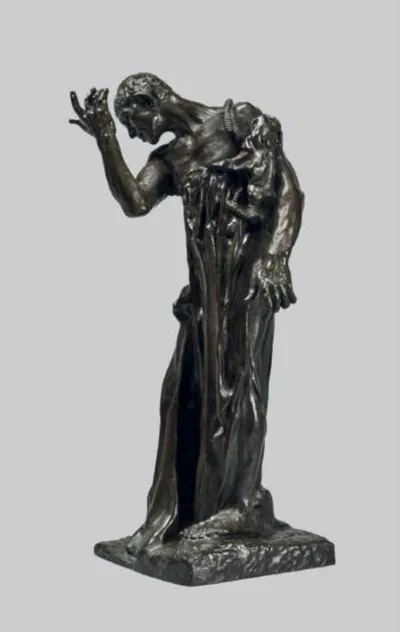
Pierre de Wiessant (1887), by Auguste Rodin
Bronze forming part of the sculptural group The Burghers of Calais.
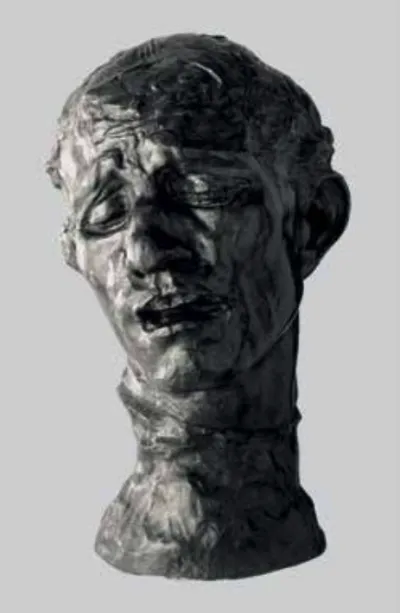
Head of Pierre de Wiessant, by Auguste Rodin
Bronze detail of the head of Pierre de Wiessant.